Visualizzazione post con etichetta Village. Mostra tutti i post

giovedì 8 agosto 2013


 2013, August 8

Sanitation program


Tiago Soares is the promoter of the Project
This program aims to start a sustainable local production and installation of septic tanks, toilets and sinks. This will allow the progressive installation of sanitation in the different households of the village, and at the same time the development of new manufacturing processes that can help the economic development of the village. Molds of the sinks, toilets and septic tanks have been designed and first prototypes are now under production. The equipment will be made of concrete with fibers to ensure the appropriate mechanical properties.


In 2013, enough funds have been raised for the first 50 installations. The program will continue in the medium and long term with the goal of having all the houses in the village equipped with a proper sanitation system.


Besides increasing the hygiene and public health standards, the program will stimulate the creation of a space of hygiene, privacy and self-esteem in the households. This new room will help developing the sense of house as more than just a sleeping place.

martedì 30 luglio 2013

2013 - July 30th

It’s the news of the 2013… after two years of traditional classes, this May we start using a little computer lab, a Language Lab.


With the three new computers gave by “Andrea Cappannoli”, this year, the language school has a new and very important tool, a Laboratory!!


This season we have seven laptop computer, 3 of them are personal, but four are permanent property of the school. Using the all seven mobiles we have, for now, classes of 14 students for any level. We mean also to allow the English and French teachers of the middle school to use the lab all around the year as support for their courses…  

The software installed is intuitive and interactive, and it’s not using any intermediate language… it means there isn’t any translation, but only a full immersion in the language you are learning. The method is the same used for mother tongue… just adsorbing.


A Computer Lab has multiple meaning for our school…

·      As a linguistic support:

-       Because it avoid the passive attitude of some student in the traditional courses

-       It helps in listening and comprehension, especially in a place like this where is not easy to find a mother tongue teacher that can follow the students for the whole academic year.

·      As a computer class:

-       It is useful to make the students better understanding the computer and the Operative System… and become confident with the keyboard, mouse, and touchpad.
It’s also important for the students that had followed the OLPC France Project at the Elementary School… using the little XO computer. The Lab give them the opportunity to upgrade their knowledge to a real computer.

martedì 11 giugno 2013

2013, June 11th


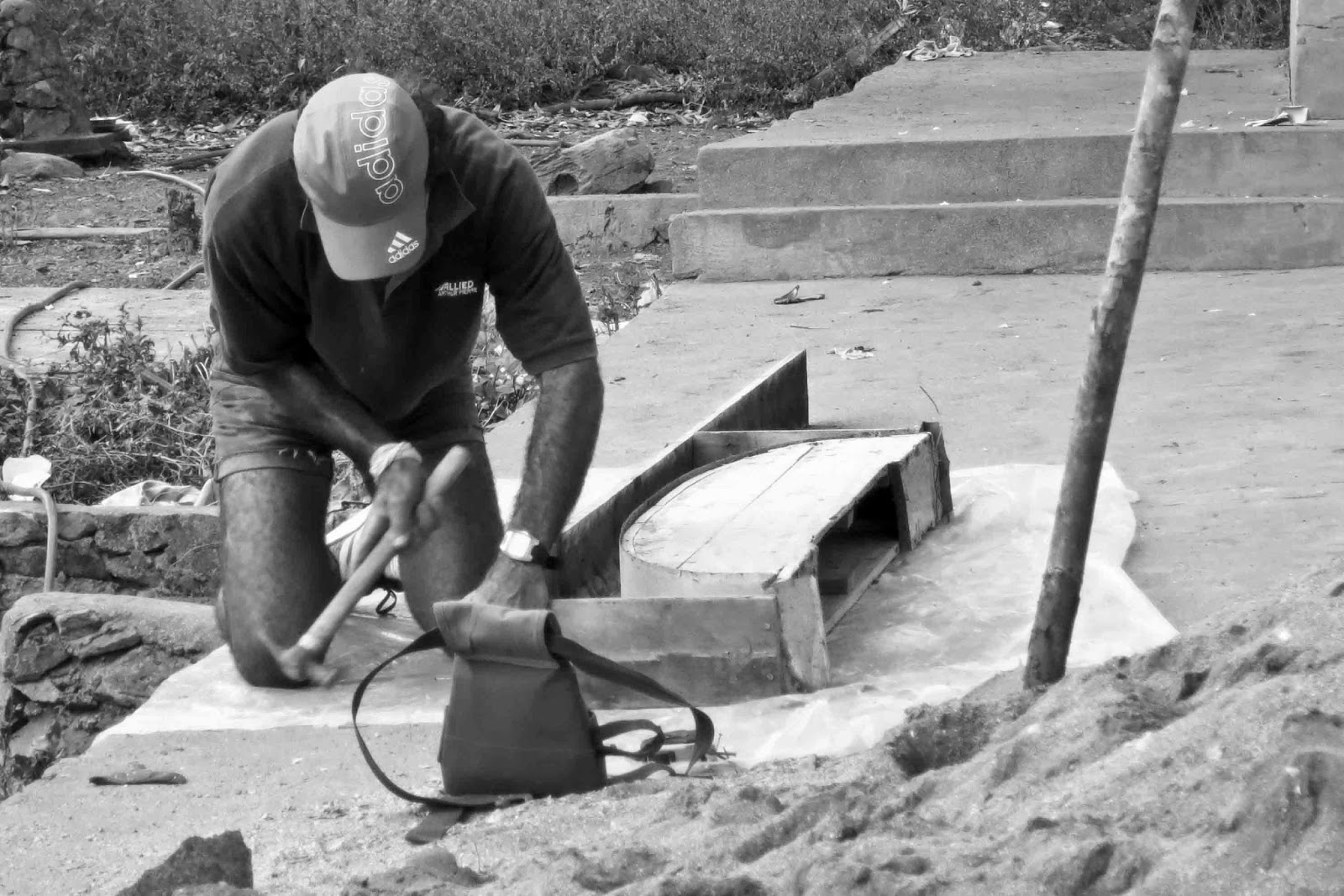
The new solutions make the everyday work an interesting laboratory of life. The gradually introduction of new techniques in masonry and architecture helps the local workers to assimilate the new concepts of construction.
Following the idea that every advancement needs the right time to be assimilate, we wait and observe the slow but inevitable evolution of the local houses… from “ravinala” (leafs) and wood to concrete.

 The bricks are built in series before to rise the walls.


 Stefano is working at a mould of an arch.


The example of the bricks in concrete built by specific pre-shaped mould was only the first step to an infinity variety of different ones. Bricks, arches, and steps for stairs are already well assimilate in the by the locals… the main idea is that everything must be easy, cheap, intuitive, and repeatable.


Even the arches of the bridge built in the 2010 were prebuild and then brought to the location.

What we are experiment now is a new method to build terrace and solai avoiding wood:


mercoledì 29 agosto 2012

Wednesday August 28th, 2012

typically refers to a gas produced by the biological breakdown of organic matter in the absence of oxygen.

Organic waste such as dead plant and animal material, animal feces, and kitchen waste can be converted into a gaseous fuel called biogas. Biogas originates from biogenic material and is a type of bio fuel.
The biogas scheme. 

Biogas is produced by the anaerobic digestion or fermentation of biodegradable materials such as biomass, manure, sewage, municipal waste, green wast, plant material, and crops. Biogas comprises primarily methane (CH4) and carbon dioxide (CO2) and may have small amounts of hydrogen sulphide (H2S), moisture and siloxanes.
The gases methane, hydrogen, and carbon monoxide (CO) can be combusted or oxidized with oxygen. This energy release allows biogas to be used as a fuel. Biogas can be used as a fuel in any country for any heating purpose, such as cooking. It can also be used in anaerobic digesters where it is typically used in a gas engine to convert the energy in the gas into electricity and heat. Biogas can be compressed, much like natural gas, and used to power motor vehicles. 
Example of biogas plant in a rural environment


In the UK, for example, biogas is estimated to have the potential to replace around 17% of vehicle fuel. Biogas is a renewable fuel, so it qualifies for renewable energy subsidies in some parts of the world. Biogas can also be cleaned and upgraded to natural gas standards when it becomes bio methane.

lunedì 23 luglio 2012


23 luglio 2012


…sono il frutto dell’esperienza di Stefano applicata alla tradizione locale sull’utilizzo della foglia della Palma del Viaggiatore, il ravinala.
Il ravinala (foglia in malgascio) ha una fibra molto resistente e flessibile e quando viene montata in serie, con lo stesso principio di sovrapposizione della tegola, ha la caratteristica di essere leggera e perfettamente impermeabile.
Un'altra importante qualità di questa tecnica di costruzione è la caratteristica di rendere i tetti particolarmente resistenti ai cicloni. Il ravinala pur non permettendo nessuna infiltrazione esterna è estremamente permeabile dall’interno, ossia permette all’aria, che si incanala durante le tempeste tropicali, di uscire verso l’alto senza provocare nessun danno rilevante alla struttura.

Le modifiche apportate da Stefano riguardano in larga parte l’ossatura portante del tetto. Un resistente e leggero sistema a capriate collegate tra loro da pali traversi sui quali vengono poi fissate le foglie stesse. La struttura, essendo montata sull’ultimo degli anelli in cemento armato dell’edificio in costruzione, ha una base solida su cui ancorarsi, risultando quindi anche estremamente duraturo nel tempo. Le prime case costruite con questa tecnica risalgono a venti anni fa e sono ancora perfettamente funzionali, l’unico problema è la vulnerabilità della foglia stessa agli agenti esterni che ne obbligano la sostituzione ogni dieci anni, contro i tre o quattro della casa tradizionale malgascia. La differenza, oltre che nella solidità della struttura, è nella pendenza stessa del tetto, che evitando la formazione di ristagni riduce la velocità di deterioramento della foglia.

domenica 1 luglio 2012

Monday – July 2nd, 2012

Weather today… ☀☁

Project activities!!
-Working ad the new building for the Agricultural Project.
-
Yesterday happened…
-Yesterday we had the annual meeting of the Economy and Development Commission. The EDC is delegated to control and analyze the develop projects proposed by Stefano Project. 
Social activities…
-Tsisy, we just rest…


WE HAVE BEEN ABLE TO PROVIDE ELECTRICITY to The Village at very low costs and the social and emotional impact of this realization is huge and continues to be so.

Children have much more time to do homework, mothers to be better Moms and the men can prolong the time dedicated to craft activities and social relations.
It's hard to talk about development without giving due importance to the factor "energy". The primary sources of energy used here are coal, wood and oil. We have chosen hydropower.

All this has been made possible thanks to an almost fortuitous encounter with Claude-Alain Nissile, a Swiss engineer who along with some of his friends created the Association ADEVE and a customized project for our energy needs.
One of the members of this association is Sergio, a smelter in Switzerland famous for having created the bell of the Olympic Games in Athens. With him we have built the mechanical parts of the bronze turbine "Pelton" which along with the electrical components form a machine which can be easily reproduced in Madagascar by local artisans.

This is an important aspect, that these micro-turbines be easily reproduced in Madagascar which would allow for the exploitation of river water, which is so readily available in this country, and thus giving several villages the possibility of producing electricity cheaply for themselves.
In our village the water reaches the turbine forced through 600 metres of pipe starting from the catchment area and then passes into the basin set in a circle and after a steep descent, arrives with its load of kinetic energy to drive the turbine.
The result is that all homes have access to electricity, the streets are lit, the cinema can show films and the children can recharge their electronic learning devices.

  • 2000 - Electricity becomes available in Antintorona. To provide energy to the school, a solar panel system is installed.
  • 2006 - Construction of the pipeline. To allow the installation of the hydroelectric turbine we first had to prepare the ground on which to run the conduit for the forced water.
  • 2007 - Installation of hydroelectric turbines. The turbine uses the water of the river which is channelled through a penstock down from 600mt.
  • 2008 - Installation of an electrical network. The energy produced from the hydroelectric turbine is continuously distributed throughout the village.
  • 2010 - The Cinema. With the simple use of an old projector and the unused cloth from a sail , a cinema has been set up in the Atelier of Mechanics and movies come to life for everyone in the village.

venerdì 22 giugno 2012

Friday - June 22nd, 2012


Weather today…

Project activities!!
-Working ad the new building for the Agricultural Project.


This will be the long weekend of the Independence Day
>Tuesday, June 26th <
Social activities…
-Theater: Terminator
-Italian Class… yesterday we had the mid-term test.